I have been reading, and rereading Eugen Herrigel's Zen in the Art of Archery for some fifteen years. Over the years, the book has spoken to me in different ways. The book is written in a simple and clear manner, and it isn't really about archery at all. All that one needs to do is to mentally substitute their discipline of choice. It is really a book about harnessing Practice Monster.
The book is so beautifully composed, and so concise, it hardly makes sense to try and summarize it here. With only eighty pages, it can be read in a couple of sittings. The material takes time to process, however, and your experience will depend on what you bring to the table. I've lost track of how many times I've read it, but I gain new insights with each reading.
With my recent thoughts and writings about the dynamics of personal practice, I've found myself lingering on the the final chapter, about Zen and swordsmanship. The hapless beginner, giddily thrusting his sword with more joy than skill . . . this summarizes my memories of being a beginner saxophonist: it was more play than anything else, and that was a beautiful moment indeed.
With formal study comes the horrible realization that there are many more skilled than yourself, and that you are hopelessly at the mercy of those with better technique. Faced with bigger and stronger opponents, the situation is impossible. In despair, you furiously practice, building a prodigious technique that can be wielded like a weapon, to slay your enemies. And yet, you fail. Again and again, we fail.
The imagined enemy can be a competing musician, or the music itself. Either way, Practice Monster is fully engaged in this part of the process. The advanced student is driven by the idea of conquering. Practice itself becomes a dreaded enemy. Self-doubt and frustration alternate between depression and rage. The monster consumes us with the illusory obsession with being the best.
It is only when we break free from the purpose of winning that we can attain the high levels of mastery. The discipline of practice must become its own purpose. Practice, no matter what we are practicing, becomes a meditation. The outcome of disciplined practice is inevitable, but that outcome has no bearing on the moment. Detached from any desire for personal gain, we freely ascend through the purity of purposeless practice.
As a professional musician, I am certainly connected to the importance of advancing my reputation. It would be transparently dishonest to imply that I am not motivated by profit, or by my own ego. My career feeds my family, after all. But there is a deeper level of practice that transcends the material world. When we learn to practice because it is like breathing, eating, or sleeping, we begin to understand when Herrigel writes that mastery is reached "when the heart is troubled by no more thought of I and You, of the opponent and his sword, of one's own sword and how to wield it – no more in even of life and death." The true master is more than just unafraid, but completely impervious to fear, temporarily unaware of its existence. Only then are we joined with the music. Practice well!
About Me
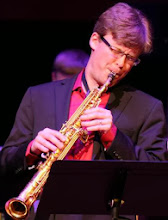
- David Pope
- Harrisonburg, Virginia, United States
- Professor of Saxophone, James Madison University
Thursday, May 9, 2013

Friday, March 8, 2013
How to Practice Sight Reading

I heard it over and over again: "Everything is great! But you need to work on your sight reading." I knew that I was a terrible sight reader. Given a little time, I could disassemble just about any piece of music into its components, shed the parts, and then put it all back together. The problem was that I had no idea how to do it on the spot. I had no real idea how to practice sight reading, other than to practice stumbling through etude books. The trouble with this is that I wasn't actually practicing anything; I was only enhancing the brain circuits that I was already using. I had great teachers, but there isn't much methodology out there about how to practice sight reading, and "just keep doing it" wasn't really working for me.
The first bit of useful information came when I was at the University of Massachusetts. I had a friend that would practice reading Clifford Brown transcriptions while he had someone else cover up the measure that he was playing with an index card. This meant that he had to quickly memorize the measure, and memorize the next measure while playing the previous one! I joined in, and we treated it like a competition, to see who could read the furthest ahead. A good deal of the material was just eighth notes, or rhythmic jazz clichés, so you mainly had to focus on memorizing the pitches quickly. Intuitively, I developed a few strategies that made it easier.
- Read the notes in groups. Find the starting pitch and look for scale steps, skips, and familiar patterns (such as triads, seventh chords, scales in thirds, etc.).
- Think relative to the key. Learn to hone in on specific notes that you are likely to see, such as the root, fifth, and seventh (the leading tone).
- Practice reading small chunks at sight. Put on the metronome, read a single measure in your mind without playing, then play the measure in time with your eyes closed. Repeat this process with larger chunks, always with the metronome, always in time.
Once you start to get a handle on grouping notes and seeing pitch patterns quickly, you will be on your way to being a better reader. But pitches are only part of the problem. If you can't execute rhythms accurately, you will quickly lose your place. Stopping and starting is a defining characteristic of poor sight reading! What to do? Here are some thoughts.
- Visually break the measure into parts. Most meters can be broken into halves. 4/4 is two chunks of two beats, so always identify beat three with your eyes - in cut time, this is "big beat two." 6/8 is two groups of three eighth notes, so look for the fourth eighth note, again like the second big beat. 9/8 has three big beats, and 12/8 has four.
- Use the big beats as landmarks. Try to notice if you are playing on the big beats, or if you are resting, or sustaining through with long notes or ties.
- Tap the subdivisions! Speak the rhythms while tapping steady subdivisions. I find it helpful to tap with two hands on my lap, always starting with the right hand, and always alternating hands. For example, when subdividing eighth notes, the downbeats will always be in the right hand, upbeats with the left. In compound time, I tap the big beats with the right hand (think RIGHT, left, left, RIGHT, left, left).
What follows is a singularly important technique for good sight reading, used by many of the good readers that I have met over the years. If you don't practice this, you will never get beyond the stopping and starting. Please, take what follows very seriously. I cannot overemphasize the point.
COUNT OUT LOUD!!!
This trick will allow you to make mistakes without getting lost, but you must practice it without your instrument, until the brain circuitry is fully formed. It takes practice and dedication, but I know of no other way to build metric confidence. Assuming that we are in 4/4 time, turn on the metronome and speak, loudly and clearly, "one, two, three, four." Say nothing else, never miss a beat, and stay perfectly with the metronome. If you have a Dr. Beat, you can even set it to speak the numbers with you. Even better! Whatever you do, remember that you must not mumble, you must never miss a beat, and you must stay in time.
To get started, take a simple etude and clap the written rhythm of the music while counting out loud. Keep your hands close together, and clap lightly, but clearly. No matter what happens, no matter how badly you bungle a rhythm, keep counting out loud. The counting must be unwavering. If you cannot do this, go slower. Practice it so slowly that you cannot possibly mess it up. Practice this every day - clap the written rhythms and count out loud. Do not speak the rhythms you are clapping!
There are numerous variations to this exercise, including speaking the subdivisions. For example, in 6/8 you could say "ONE-tee-ta, Two-tee-ta." In a funky, syncopated etude, you could count "ONE-ee-an-da, TWO-ee-an-da." However you choose the count, make it consistent, and don't stop when you make a clapping error.
In time, you will be able to internalize the counting while playing your instrument. This is a slow process, and it takes a long time to make progress. Practice it every day. I know of no other way to develop the ability to stay in the meter, even when making mistakes. Don't stop, and if you can't get through it, GO SLOWER. Slow practice is always best, even if it is frustrating and time consuming. Don't let Practice Monster get the best of you! Patience is the key.
Most of what I have outlined can be practiced with nothing more than a metronome and a couple of simple etude books - those old beginner books that you have lying around are perfect to get started. I also recommend the following to my students:
Pasquale Bona, Complete Method for Rhythmical Articulation
Good luck, and remember to COUNT OUT LOUD!
Good luck, and remember to COUNT OUT LOUD!
Monday, February 11, 2013
New website!
I am pleased to announce my new website, inspired by Practice Monster, and specifically dedicated to saxophonists.
To get regular updates, follow me on twitter @PracticeMonster.

To get regular updates, follow me on twitter @PracticeMonster.

Tuesday, December 18, 2012
Noah, Practice Monster, and the Altissimo G
My children get their music lessons at home, as my wife teaches them piano. I'm on woodwind duty. Yesterday was a normal day, but something special happened during my son's saxophone lesson that I was lucky enough to catch on video.
My son is a talented young man, but I wouldn't call him a prodigy. He's a regular, eleven year-old boy. I often have to threaten him with no video games to get him to do anything, including practicing. Yesterday was just like every other day, with me yelling something about laziness and "You'll get no Skylanders this weekened!" Even the lesson wasn't terribly special, as he reluctantly played through his scales, complaining that low D-flat to E-flat is "too hard. I can't do it!" (Of course, he eventually played it without a problem.)
Then, there was a spark. After playing his chromatic scale to high F#, he said, "Dad, will you show me how to play a high G?" This is the most notoriously difficult note on the alto. Untold numbers of university students have squeaked it in Paul Creston's sonata. I once squeaked it on a recital performance of Warren Benson's Aeolian Song. It's such a pain to master, I even posted my own YouTube masterclass on the subject (http://www.youtube.com/watch?v=2OOUUXczUh4).
I showed Noah this particular exercise, and he stumbled through it. After a couple of failed attempts, the note popped out. I couldn't hide my surprise. Noah suggested how funny it would be to make a YouTube video of him playing the high G, so I turned on the camera. I did this to encourage him, and I didn't actually think that we would capture anything worth posting. As luck would have it, I was about to catch a complete practice event.
As you watch the video, notice that he fails over and over again. He had only played one high G in his life before I turned the camera on, and it was mostly by luck, but now the note was in his ear. That single success fueled his perseverance, but his eyes and face show his frustration. Notice the determined breath he takes at 0:25, and the head-in-hand moment that follows. I made the teaching decision, in the moment, to just quietly encourage him, letting him figure it out on his own. Somehow, even as he squawks out some accidental multiphonics, he maintains his momentum. He slows down the exercise, explores the sounds, and he keeps going. Failed attempts, one after another. Then, expecting more failure, he realizes that he has done it . . . check out the delayed reaction with his eyes at 1:36.
Sensing that it was time for a break, I turned the camera off and we worked on some jazz for a few minutes. We went into another room and I played piano for him to practice improvising on the blues. Then, we turned the camera back on, and he proceeded to execute the exercise three times in a row. It seems that taking a break gave his brain a chance to let it set in. He worked through the frustration just enough to make the breakthrough, without succumbing to the frustration of the Practice Monster.
There is nothing unusual about this sequence of events. Noah practices every day, but not for an inordinate amount of time. He requires constant encouragement, and is often kicking and screaming all the way to success. This video just happens to encapsulate a particularly successful practice session:
- Inspiration/ignition
- Failure
- Determination
- Failure
- Failure
- Calming down
- More failure
- Palms in eye sockets
- More Determination
- Even more failure
- Success
- Rest
- Success!!!
Monday, November 26, 2012
We Are Stardust
Readers of this blog know that my approach to practice is based on patience, tenacity, and science. I read a lot of science books, admittedly many that are beyond my ability to fully comprehend. The process is frustrating, as I need to keep looking things up, rereading entire chapters, reviewing the math that I never really learned in the first place, and eventually putting the book down because my brain has completely shut down. There is also an occasional moment of revelation, especially when something rings true to my own experiences. I recently had such a moment of glory while reading Richard Dawkins' The Magic of Reality. (If you are so inclined, the iPad version is excellent, filled with clever animations, games, and beautiful illustrations.)
I was reading a beautifully explained passage on the slow and gradual nature of evolution. Dawkins guides the reader through a thought experiment where one takes a picture of their parents, grandparents, great-grandparents, etc., and lays them out in huge stack. If we go back in history a very long way, we arrive at some ancestors that look very different from the way we look today. This imaginary march backwards through time leads us to ancestors that we share with other species, and inexorably into the sea, where all life began.
So what? What does this have to do with practicing to achieve musical mastery? Wait for it . . .
Dawkins points out that if we take any two adjacent portraits from the stack, the child will always very closely resemble the parent. In fact, a fistful of generations will be essentially identical in general appearance. Evolution happens so slowly that it is impossible to observe without taking large leaps through the pile. (Adaptations happen faster with living things that reproduce more quickly, which is why you don't want the flu shot from last year!)
When it comes to talent farming, the changes occur much, much faster than the glacial creep of evolution. But relative to the cosmic brevity of our lives, acquisition of mastery is a very gradual process. Dawkins reminds the reader that there is never a single day when a baby is suddenly a toddler, or a child clearly an adult. There will never be a single moment when I look into the mirror and see an old man in the reflection, but no matter how slowly the changes occur, I will eventually be a graying geezer.
The pursuit of mastery plays out exactly in this manner. There is never a single day that we triumphantly leap onto the stage as a heroic virtuoso that didn't exist in the moments before that concert. Skill doesn't click on like a light switch. The days look much the same, indistinguishable from each other. There will be perceived moments of sudden victory, but these are more like the teenager suddenly recognizing a grown-up in the mirror. Change doesn't happen suddenly, but it creeps up on us.
The next time you are feeling frustrated about your progress, consider that you didn't change from a toddler to a teenager overnight, but that change surely happened! Investing in regular practice will yield slow, steady progress - too slow to measure in short intervals. Keep working hard, and remember that every great artist started as a helpless baby, and that once upon a time, every atom in your body was forged in a star.
I was reading a beautifully explained passage on the slow and gradual nature of evolution. Dawkins guides the reader through a thought experiment where one takes a picture of their parents, grandparents, great-grandparents, etc., and lays them out in huge stack. If we go back in history a very long way, we arrive at some ancestors that look very different from the way we look today. This imaginary march backwards through time leads us to ancestors that we share with other species, and inexorably into the sea, where all life began.
So what? What does this have to do with practicing to achieve musical mastery? Wait for it . . .
Dawkins points out that if we take any two adjacent portraits from the stack, the child will always very closely resemble the parent. In fact, a fistful of generations will be essentially identical in general appearance. Evolution happens so slowly that it is impossible to observe without taking large leaps through the pile. (Adaptations happen faster with living things that reproduce more quickly, which is why you don't want the flu shot from last year!)
When it comes to talent farming, the changes occur much, much faster than the glacial creep of evolution. But relative to the cosmic brevity of our lives, acquisition of mastery is a very gradual process. Dawkins reminds the reader that there is never a single day when a baby is suddenly a toddler, or a child clearly an adult. There will never be a single moment when I look into the mirror and see an old man in the reflection, but no matter how slowly the changes occur, I will eventually be a graying geezer.
The pursuit of mastery plays out exactly in this manner. There is never a single day that we triumphantly leap onto the stage as a heroic virtuoso that didn't exist in the moments before that concert. Skill doesn't click on like a light switch. The days look much the same, indistinguishable from each other. There will be perceived moments of sudden victory, but these are more like the teenager suddenly recognizing a grown-up in the mirror. Change doesn't happen suddenly, but it creeps up on us.
The next time you are feeling frustrated about your progress, consider that you didn't change from a toddler to a teenager overnight, but that change surely happened! Investing in regular practice will yield slow, steady progress - too slow to measure in short intervals. Keep working hard, and remember that every great artist started as a helpless baby, and that once upon a time, every atom in your body was forged in a star.
Tuesday, October 9, 2012
Plateau busting with short-term goals
It happens to everyone, sooner or later – the dreaded practice plateau. You feel like you haven't made any progress in a long time. It's gotten so bad that you are having a hard time facing practicing at all. The thought of banging your head against the wall is too much to bear. You are depressed. You avoid practicing altogether.
You are not alone. This happens to everyone. As you attain a higher level of skill, the learning curve gets steeper. This is the primary reason that the great virtuosi are vastly outnumbered by mediocre amateurs. Along the ascent, it is increasingly difficult to resist the urge to give up. It's a bit like the analogy of the person taking steps towards a wall, each step half the distance of the previous one. That person ever more slowly advances towards the goal, without ever actually reaching it. It's maddening.
Practicing would be a far less frustrating affair if we could easily measure our progress from one session to the next. Imagine if you had one of those "downloading" progress bars floating underneath you as you practiced, telling you how close you were to completing that new sonata or jazz tune! Although we are building neural connections with every repetition, it feels more like endless plateaus that suddenly break through to new levels, almost without warning. Enduring each plateau is a test of our commitment. The plateau is the perceived barrier between where we are, and where we are trying to go.
This barrier is perceived. It is not real. Improvement creeps in, almost too slowly to measure. This is especially dangerous when we are measuring the wrong things. When you find yourself at one of these practice plateaus, it is tempting to look at that those far-away goals and to feel overwhelmed. These are the precise moments where we decide what kind of artist we will be. Will we keep pushing up the hill, or simply surrender?
I have survived many of these moments with a simple strategy that works every time. Set a small, easily achievable goal. Make the goal tiny, something like "learn one measure." The smaller the goal, the better. Make it something that you could conceivably accomplish in 20 minutes or less. Rather than trying to learn an entire recital program, or a whole piece of music, focus on a very small chunk. This next part is very important, so read it twice. Read it twice.
Focus completely on the small amount of material and sustain your concentration on only that amount, without adding anything until the material becomes effortless.
Practice isn't magical. Every minute, every day, it always works in the same way. Your brain slowly enhances the circuits that you use the most. These circuits are built more efficiently when we repeat simple actions, over and over again. Although the big picture comes together too slowly to recognize, the tiny aspects are much easier to deal with. An attainable, short-term goal will bring a sense of accomplishment, and that reward will go a long way towards curing your practice plateau blues.
Sunday, September 2, 2012
God Mode: How Modern Video Games are Killing Little Practice Monsters
The title of this post might lead you to believe that I am against video gaming. Nothing could be further from the truth. I love video games, and I always have. This will date me, for sure, but I lusted over my neighbors' Atari systems. In junior high school, my parents gave me an original Nintendo system. I spent a summer slogging it out with Super Mario Brothers. As an undergraduate, I practiced and studied all day, and played Sonic the Hedgehog all night (sometimes, literally). My kids think the Wii was for them, but I love that thing. However, something is wrong with these new games, and I think it speaks volumes about what is happening to our society.
The Legend of Zelda (and I'm talking about the original) was an amazing game. It required strategy, problem solving, tenacity, and there was the small matter of trying not to die. Virtually all of the games of my youth had one thing in common: if you died, you had to start over. Okay, maybe you had to go back to the beginning of a level, or back to a checkpoint, but sooner or later, you were going to have to start the whole thing over again. It was brutal. I remember falling off the couch, shaking my fist (and controller) to the heavens, shouting "Nooooooooooo!!!"
My son loves the Lego games on Wii . . . Star Wars, Indiana Jones, Harry Potter. These are seriously great games. There are so many levels, each game is like a universe. The action is non-stop, and the sensory stimulation never lets up. With a controller in each hand, you just keep grabbing those golden lego coins, slashing away at enemies. If you die, you get right back up again. You can play forever, and you never have to go back to the beginning. True, you do have to solve some puzzles along the way, but you could literally just run around and find interesting things to do forever. Literally, forever.
I can remember when this change started. In grad school, I had a copy of Doom on my pizza box-sized Power Mac 6100. My buddies drooled over the 8 megs of ram. For real. Doom was fun, but there was a way to really maximize the fun . . . internet cheat codes. Type in the right word and you could have infinite health, weapons, ammo. I think there was a "god mode" where you could even see the hidden enemies (that might have been another game, but that does seem to ring a bell). Why bother really learning how to play the game when you could use a cheat code, and then simply enjoy the sensory extravaganza? It was awesome. Or was it?
Games are great for burning off stress, and these days, I don't have time to learn a complicated video game. Doom with invincibility meant that I could enjoy the game without really being any good at it. It didn't matter. In fact, if you played with the cheat codes on for long enough, you might actually believe that you were good at the game. All the rewards with none of the work. None of the dying right before slaying the boss that takes a half hour to get back to. With the cheat codes, you really were the god of the game.
Video games today are way more realistic than those old NES things. These new games are so good, you really feel like you can strike out A-Rod. You can bowl strike after strike. You can dunk. You can play the guitar. (I don't know about you, but I can't do ANY of those things!) This feeling of reality is powerful, and the games are designed to keep you playing. I concede that there are certainly exceptions, but my experience with the games that my children and their friends play is profoundly clear: the games are designed to hook you by keeping the action coming, and it is practically impossible for your character to "die." At least not in the way that poor old Pac-Man would go down in flames with his little death tune. These games are engaging, empowering, and in most cases, overwhelming.
This might be a leap, and purely speculative on my part, but it seems to me that the video game experiences of my youth taught me to come back swinging, and to keep practicing, but these new games are more about just keep playing. When it comes to real skill building, there are no cheat codes. You can't download mastery like code from the matrix. You have to be willing to start from the beginning, and failure will knock you back, sometimes hard. You can't just blink and hop back up like nothing happened. It is seriously difficult to pull yourself up, to learn from your mistakes - to go on, in spite of the seemingly insurmountable challenges ahead. In life, there is no "god mode."
One could easily argue that the games are more of a reflection of society than the other way around. No doubt, there is plenty of truth to that chicken v. egg scenario. But the point of this blog is that we become what, and how we practice. I enjoy these new games. I even sometimes play lightsaber duel when my kids are at school (I'm in trouble when they start reading my blog). As immersive and as fun as it is to play these games, I always stop playing because I've had enough - never because I "died," and if you never have to go back to the beginning, if you never have to repeat and refine, how are you getting better? You aren't.
The Legend of Zelda (and I'm talking about the original) was an amazing game. It required strategy, problem solving, tenacity, and there was the small matter of trying not to die. Virtually all of the games of my youth had one thing in common: if you died, you had to start over. Okay, maybe you had to go back to the beginning of a level, or back to a checkpoint, but sooner or later, you were going to have to start the whole thing over again. It was brutal. I remember falling off the couch, shaking my fist (and controller) to the heavens, shouting "Nooooooooooo!!!"
My son loves the Lego games on Wii . . . Star Wars, Indiana Jones, Harry Potter. These are seriously great games. There are so many levels, each game is like a universe. The action is non-stop, and the sensory stimulation never lets up. With a controller in each hand, you just keep grabbing those golden lego coins, slashing away at enemies. If you die, you get right back up again. You can play forever, and you never have to go back to the beginning. True, you do have to solve some puzzles along the way, but you could literally just run around and find interesting things to do forever. Literally, forever.
I can remember when this change started. In grad school, I had a copy of Doom on my pizza box-sized Power Mac 6100. My buddies drooled over the 8 megs of ram. For real. Doom was fun, but there was a way to really maximize the fun . . . internet cheat codes. Type in the right word and you could have infinite health, weapons, ammo. I think there was a "god mode" where you could even see the hidden enemies (that might have been another game, but that does seem to ring a bell). Why bother really learning how to play the game when you could use a cheat code, and then simply enjoy the sensory extravaganza? It was awesome. Or was it?
Games are great for burning off stress, and these days, I don't have time to learn a complicated video game. Doom with invincibility meant that I could enjoy the game without really being any good at it. It didn't matter. In fact, if you played with the cheat codes on for long enough, you might actually believe that you were good at the game. All the rewards with none of the work. None of the dying right before slaying the boss that takes a half hour to get back to. With the cheat codes, you really were the god of the game.
Video games today are way more realistic than those old NES things. These new games are so good, you really feel like you can strike out A-Rod. You can bowl strike after strike. You can dunk. You can play the guitar. (I don't know about you, but I can't do ANY of those things!) This feeling of reality is powerful, and the games are designed to keep you playing. I concede that there are certainly exceptions, but my experience with the games that my children and their friends play is profoundly clear: the games are designed to hook you by keeping the action coming, and it is practically impossible for your character to "die." At least not in the way that poor old Pac-Man would go down in flames with his little death tune. These games are engaging, empowering, and in most cases, overwhelming.
This might be a leap, and purely speculative on my part, but it seems to me that the video game experiences of my youth taught me to come back swinging, and to keep practicing, but these new games are more about just keep playing. When it comes to real skill building, there are no cheat codes. You can't download mastery like code from the matrix. You have to be willing to start from the beginning, and failure will knock you back, sometimes hard. You can't just blink and hop back up like nothing happened. It is seriously difficult to pull yourself up, to learn from your mistakes - to go on, in spite of the seemingly insurmountable challenges ahead. In life, there is no "god mode."
One could easily argue that the games are more of a reflection of society than the other way around. No doubt, there is plenty of truth to that chicken v. egg scenario. But the point of this blog is that we become what, and how we practice. I enjoy these new games. I even sometimes play lightsaber duel when my kids are at school (I'm in trouble when they start reading my blog). As immersive and as fun as it is to play these games, I always stop playing because I've had enough - never because I "died," and if you never have to go back to the beginning, if you never have to repeat and refine, how are you getting better? You aren't.
Subscribe to:
Posts (Atom)