Please, forgive me for the relatively long hiatus. I've been extremely busy with performances. In fact, I don't think I've ever been this busy. That is a very good thing! We all like to have our calendars filled with gigs, but we should also be careful what we wish for. It only takes one or two extra commitments to go from feeling good to being totally overwhelmed. Practice Monster can help, but only if we train for success under pressure.
Have a Schedule
Mark down all your concerts and rehearsals on the calendar - that should be obvious. From there, assess how much music you have to learn, and divide it up. Literally assign yourself a page a week, or 2 lines per day; get out your calculator, and split things up into manageable chunks that have hard deadlines. Block out your practice for each and every day, and set very specific goals. Get excited about attacking the music for the day, and keep on schedule.
Keep the Beast in Blinders
Practice Monster has a way of freaking out when he feels overwhelmed. Use the schedule to distract him. Focus intensely on learning the new material on your schedule, and on reviewing what you have already learned. As long as your schedule is reasonable, and you allow extra time at the end to synthesize everything into a finished product, there is no need to fret about the looming performances. Get yourself organized at the beginning, and then try not to look to far ahead. Focus on the work at hand, and on the short-term deadline.
No Rest for the Weary
I recently played a concert at a major venue. The preparation was long and intense. It would have been very easy to take a few days off. I started the very next day by forcing myself to practice for the next project at 8:30AM. I was aiming for 8AM, but I'm only human! Excellence is habit forming, but so is lounging about. When you have work to do, go do it. The sooner, the better.
Just Say Yes - Unless . . .
It is very important to say yes (read Bill Shatner's new book). I can't count the number of times I reluctantly agreed to do something, and it turned out to be a wonderful experience. At different times in our careers, the stipulations for what we are willing to do will change. (I don't play very many weddings anymore, and performing gratis is rare.) While it is important to seize opportunities, we must also be cautious not to go overboard. There are limits to what an individual can do, and it sometimes isn't worth the stress and strain to do "just one more gig." Always lean towards saying yes, but respect your schedule, and try to have a life outside of work.
There is a time to put Practice Monster to bed. And with that, I say goodnight!
About Me
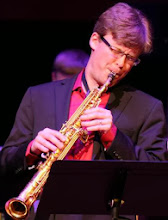
- David Pope
- Harrisonburg, Virginia, United States
- Professor of Saxophone, James Madison University
Sunday, October 23, 2011

Tuesday, August 23, 2011
The Canvas of Creativity
After my last post (Coltrane's Brain . . . ), I had an interesting email exchange with a friend. He made some points about talent and genius that I would like to expound upon.
The purpose of the last post wasn't purely Coltrane worship, which has been overdone already, to the point of absurdity. Rather, my point is that his recorded works provide documentation of the transformative power of effective practice. What makes Trane so special, in my opinion, is that he perfects his technique to the point that he can sometimes execute ideas faster than he can think them up. One Down, One Up is one of those rare moments when he is able to temporarily equalize the velocity of his technique with the creativity itself.
This is the mark of a mature genius - insight through applied skill. Take for example the thought experiments of Albert Einstein. Einstein spends so much time thinking about specific ideas, he must have myelinated circuits that related to deep thought, giving him access to insights that were far outside commonly accepted ideas. In 1919, scientists prove what Einstein predicted to be true four years earlier: gravity bends light. This changes the way we look at physics forever, and although many scientists found the idea to be impossible, Einstein had already worked it out in his mind. Unfortunately for us, the birth of an idea is impossible to observe - that moment is experienced by the thinker alone.
Improvised music makes for an ideal look at the speed of creativity because the canvas is time - we listen to the creative act as it unfolds. The level of creativity varies, depending on the musician, and the style. The creativity of bebop is different than that of the later works of Coltrane, simply because bop relies more on assembling clichéd constructs to outline chord changes. While bebop is a difficult and nuanced style of playing, the expressionism of "the new thing" attempts to break free from building with pre-composed chunks of music. Coltrane gives particular voice to this movement because his technical abilities have been so finely honed. As much as I love the avant garde playing of Archie Shepp and Albert Ayler, they rely much more on entropy, simply because they lack the technical circuitry that Coltrane earns throughout the 1950's. (I'm not judging one music to be better, or worse - just different, on a purely technical level.)
The creative genius of writers, composers, theoretical physicists, and philosophers is much more difficult to examine with proper perspective. A writer's talent is built up with sketches and drafts that are carefully hidden from the public eye, and creative thought is hidden away in a tangle of white matter. In most disciplines, it is impossible to observe the precise moments of insight, which is exactly why Live at the Half Note is so special.
Imagine that Coltrane is a supersonic jet, where his technique is the sound of the engine, and his mind is the aircraft. As his processing speed increases, he starts to catch up with his own sound waves, until they start to pile up at the front of the vehicle. When his creative velocity breaks the technique barrier, we hear the metaphorical sonic boom of Trane cutting through all that piled up sonic energy. That sonic boom is common to all genius, but rarely is it captured for posterity.
The purpose of the last post wasn't purely Coltrane worship, which has been overdone already, to the point of absurdity. Rather, my point is that his recorded works provide documentation of the transformative power of effective practice. What makes Trane so special, in my opinion, is that he perfects his technique to the point that he can sometimes execute ideas faster than he can think them up. One Down, One Up is one of those rare moments when he is able to temporarily equalize the velocity of his technique with the creativity itself.
This is the mark of a mature genius - insight through applied skill. Take for example the thought experiments of Albert Einstein. Einstein spends so much time thinking about specific ideas, he must have myelinated circuits that related to deep thought, giving him access to insights that were far outside commonly accepted ideas. In 1919, scientists prove what Einstein predicted to be true four years earlier: gravity bends light. This changes the way we look at physics forever, and although many scientists found the idea to be impossible, Einstein had already worked it out in his mind. Unfortunately for us, the birth of an idea is impossible to observe - that moment is experienced by the thinker alone.
Improvised music makes for an ideal look at the speed of creativity because the canvas is time - we listen to the creative act as it unfolds. The level of creativity varies, depending on the musician, and the style. The creativity of bebop is different than that of the later works of Coltrane, simply because bop relies more on assembling clichéd constructs to outline chord changes. While bebop is a difficult and nuanced style of playing, the expressionism of "the new thing" attempts to break free from building with pre-composed chunks of music. Coltrane gives particular voice to this movement because his technical abilities have been so finely honed. As much as I love the avant garde playing of Archie Shepp and Albert Ayler, they rely much more on entropy, simply because they lack the technical circuitry that Coltrane earns throughout the 1950's. (I'm not judging one music to be better, or worse - just different, on a purely technical level.)
The creative genius of writers, composers, theoretical physicists, and philosophers is much more difficult to examine with proper perspective. A writer's talent is built up with sketches and drafts that are carefully hidden from the public eye, and creative thought is hidden away in a tangle of white matter. In most disciplines, it is impossible to observe the precise moments of insight, which is exactly why Live at the Half Note is so special.
Imagine that Coltrane is a supersonic jet, where his technique is the sound of the engine, and his mind is the aircraft. As his processing speed increases, he starts to catch up with his own sound waves, until they start to pile up at the front of the vehicle. When his creative velocity breaks the technique barrier, we hear the metaphorical sonic boom of Trane cutting through all that piled up sonic energy. That sonic boom is common to all genius, but rarely is it captured for posterity.
Monday, August 22, 2011
Coltrane's Brain: Live at the Half Note
John Coltrane was a living shrine to the Practice Monster. Sometimes I wonder if he broke the wild stallion and rode into the horizon, or if it was the beast that conquered the man, completely consuming him. Perhaps they were twins, somehow equal partners in a furious dance. Regardless, we can learn a great deal from listening to the recorded documentation of the musical career of one of the greatest musicians of all time.
Listen to the famous recording of the young Trane, stumbling through Hot House with the US Navy Band in 1946. At 20 years old, he is certainly not anything special, and very comparable to many of the mediocre young saxophonists I hear today. Fast forward to 1957's Blue Train, and we find a fully formed master. He certainly would have been able to accomplish the requisite 10,000 hours of practice to get to this point, and from what we know about his practice habits, he probably far surpassed that mark.
To my ears, Coltrane spends the next, and ultimately the final ten years of his life developing at a rate that eclipses all but the greatest masters in the history of humankind, regardless of discipline. He becomes a walking deep practice machine, honing his ideas and technique whenever he had the horn within reach. Improvisation and practice become one act. His solos have a halting sense of phrasing because he is right at the edge of his capabilities, constantly correcting his course, struggling to get it right. He is a musical Einstein, redefining possibility.
Thanks to a bit of good luck, we have access to one of the most profound documents of myelin in action that I know of. One Down, One Up, from the posthumously released "Live at the Half Note" allows us to peek into the mind of Coltrane. We can hear him building circuits, correcting mistakes, repeating complex ideas - all in real time. Reportedly, this was the only live recording in JC's personal collection that he backed up with a second copy. Even he was aware that this was an extraordinary performance, and generations of post-Trane tenor players view this tape as a kind of holy grail.
You should listen to the entire track, an astonishing 27 minute excerpt of an even longer performance, but the heavy myelination occurs between 22:00 and 24:40. It should be obvious to anyone with a reasonably developed ear that he is working through some extremely complex melodic material here, stopping and starting, increasing the speed, and eventually shifting into a gear that most of us will never know. I believe that we are actually hearing him put the finishing touches on a few pieces of neural circuitry. At 24:40, he moves on to play some familiar sounding Coltrane clichés, perhaps because he had exhausted himself. The level of physical intensity here is amazing, but what is happening inside his mind is the improvisation olympics.
In John Coltrane, Practice Monster seemed to have found his master, or at least his equal. Even if this type of jazz isn't your favorite style, there is a great deal to be learned from this recording. I strongly encourage everyone to study this performance, at least on a conceptual level. This is the sound of talent pushing itself beyond all accepted boundaries. It is the sound of the final moments of a red giant, fusing iron at its core to create the rarest stuff in the universe.
Friday, August 12, 2011
The Talent Diet?
We know that myelin in the brain is the key to developing new skills, and obtaining mastery. Myelin is composed mostly of fat, but according to the Franklin Institute, the kind of fat matters. Oleic acid is what you want, and you can find it in fish, olive oil, almonds, peanuts, and avocados. Not only is a good diet helpful, but a poor diet is destructive. If you eat a lot of fast food, those trans fats are going to make their way into your myelin sheaths. Trans fat inhibits proper performance of the myelin sheath.
It is even possible that early humans surpassed Neanderthals because the diet of the latter was mostly red meat, leaving the Neanderthal brain undernourished. Early humans had a more balanced diet, and seafood could have helped them to evolve bigger, more powerful brains.
This information is particularly important for college students. It appears that a balanced diet rich in good fat will actually help you to build skills more quickly by supporting myelin production. If you starve yourself, or consume trans fats, you are actually slowing your progress.
The next time you sit down to practice, make sure that you have given your body the fuel it needs to make the most of your hard work!
It is even possible that early humans surpassed Neanderthals because the diet of the latter was mostly red meat, leaving the Neanderthal brain undernourished. Early humans had a more balanced diet, and seafood could have helped them to evolve bigger, more powerful brains.
This information is particularly important for college students. It appears that a balanced diet rich in good fat will actually help you to build skills more quickly by supporting myelin production. If you starve yourself, or consume trans fats, you are actually slowing your progress.
The next time you sit down to practice, make sure that you have given your body the fuel it needs to make the most of your hard work!
Friday, July 29, 2011
Talent = Inception + Work
The film Inception is based upon the concept that the most powerful thing in the world is an idea. Moreover, that idea cannot be consciously planted in the mind of an individual . . . it has to be born there, if only on the conscious level. Daniel Coyle's book The Talent Code offers some compelling evidence that talent is nothing more than skill that is a product of intense and efficient practice, fueled by inception. (Coyle calls this ignition, but the idea is the same.)
Practicing music was something I did because it was fun and interesting to me, until something huge happened. I was listening to the radio, a program on Boston public radio called Eric in the Evening, when I heard something that blew my mind. It was one of the Mingus Changes albums, and the late George Adams was doing things with the tenor that I never dreamed possible. He played with speed, range, and reckless abandon. Something in my brain jolted with electricity at the moment of inception: If I practice hard enough, I could do that! In retrospect, I also see that I didn't want to have to work myself to death in a factory like my father, so the idea really had the urgency of I must practice hard enough . . .
As a university professor, I have witnessed this again and again. A student only works as hard as they want to, and the level of commitment is directly proportional to the power of the idea that lives in the mind. The student that isn't convinced that they want to be great will never be great. Deeper still, one cannot force an idea to take hold. Being in an inspirational environment is a key element, but each individual must eventually turn on the engine of internal motivation.
For an individual that hasn't experienced inception, Practice Monster is the enemy, constantly expressing the subconscious feeling of "I can't do this." Meanwhile, Practice Monster is the friend of the person who deeply believes that they can do it, and that they must do it. While there may be something to the physiology of talent, certain body types or physical structures making some skills easier to obtain, I have my doubts that talent really exists, at least in the way we love to over-romanticize it. We say that someone is talented after the fact. No matter how much we wish it were true, nobody is born with skills pre-wired. Talent is earned.
So . . . what kind of Practice Monster do you have?
Practicing music was something I did because it was fun and interesting to me, until something huge happened. I was listening to the radio, a program on Boston public radio called Eric in the Evening, when I heard something that blew my mind. It was one of the Mingus Changes albums, and the late George Adams was doing things with the tenor that I never dreamed possible. He played with speed, range, and reckless abandon. Something in my brain jolted with electricity at the moment of inception: If I practice hard enough, I could do that! In retrospect, I also see that I didn't want to have to work myself to death in a factory like my father, so the idea really had the urgency of I must practice hard enough . . .
As a university professor, I have witnessed this again and again. A student only works as hard as they want to, and the level of commitment is directly proportional to the power of the idea that lives in the mind. The student that isn't convinced that they want to be great will never be great. Deeper still, one cannot force an idea to take hold. Being in an inspirational environment is a key element, but each individual must eventually turn on the engine of internal motivation.
For an individual that hasn't experienced inception, Practice Monster is the enemy, constantly expressing the subconscious feeling of "I can't do this." Meanwhile, Practice Monster is the friend of the person who deeply believes that they can do it, and that they must do it. While there may be something to the physiology of talent, certain body types or physical structures making some skills easier to obtain, I have my doubts that talent really exists, at least in the way we love to over-romanticize it. We say that someone is talented after the fact. No matter how much we wish it were true, nobody is born with skills pre-wired. Talent is earned.
So . . . what kind of Practice Monster do you have?
Monday, July 25, 2011
Starving Mediocrity to Death
Mediocrity is infectious and contagious. It sneaks into our work and quietly spreads into everything that we do. If you allow mediocrity to slide into what you practice, it will feed on everything around it. If you myelinate sloppy circuits, you will become a master of mediocrity.
As you practice, force yourself to stop when you stumble. Go back, fix things as you go, and pay attention to the details. It is far better to practice one measure for an hour, if that is what it takes. By demanding perfection in the the preparation process, you can literally starve mediocrity to death.
Habits are easy to form, and tend to be one-way streets. Myelin breaks down very slowly, and the only way to get rid of a bad habit is to "over-write" it with a good one. You literally have to myelinate a new circuit strong enough to overpower the old one. Be thoughtful about the things you might be accidentally cementing through repetition, and spend most of your time focusing directly on your weaknesses. SMASH!!!
As you practice, force yourself to stop when you stumble. Go back, fix things as you go, and pay attention to the details. It is far better to practice one measure for an hour, if that is what it takes. By demanding perfection in the the preparation process, you can literally starve mediocrity to death.
Habits are easy to form, and tend to be one-way streets. Myelin breaks down very slowly, and the only way to get rid of a bad habit is to "over-write" it with a good one. You literally have to myelinate a new circuit strong enough to overpower the old one. Be thoughtful about the things you might be accidentally cementing through repetition, and spend most of your time focusing directly on your weaknesses. SMASH!!!
Wednesday, July 20, 2011
Myelinate This!
Summer reading is one of the things I truly look forward to each year. My brother-in-law hipped me to Daniel Coyle's fascinating book The Talent Code. Coyle does a great job of clearly explaining what he calls deep practicing, and why it works. Practice Monster knows the deep practice zone well, and you'd be smart to read this book right away. It has everything to do with what I've been blogging about.
Here is the basic idea. We have something like 100 billion neurons in our brains. (Yes, you read that number correctly.) In order to perform tasks, the brain builds circuits of neurons that must fire in a certain order, and with perfect timing. The problem is that electricity is leaking all over the place, mucking up the speed and timing of the circuit. Enter the oligodendrocytes.
Axons are the nerve-fibers that literally carry the electrical signals in our brains. When we practice, anything at all, special cells called oligodendrocytes manufacture a fatty insulator called myelin. Myelin wraps around the axon, insulating the electrical connection. With less leakage, the signal is stronger . . . and faster. The more you repeat a task, the more myelin wraps around the wires in that particular circuit.
Coyle describes deep practice as slowly stumbling into errors, going back to correct, and ruthlessly repeating. He describes the facial expression of deep practice as "Clint Eastwood." (I love it!) This is precisely the state of mind that occurs when Practice Monster is awake, but he's still on the leash. Coyle does a great job of combining current scientific research with time in the field, studying everything from musicians to chess players to athletes. Remember, skills are skills, and the brain doesn't differentiate.
If you are a student or a teacher, you need to read this book. At the very least, it provides some concrete affirmation of what we already know, but you are likely to get some great ideas about how to refine your practice, and coaching techniques. By taking ourselves to the very edge of our abilities, and making that the normal practice mode, we can efficiently insulate our internal circuitry. Get to work!
Here is the basic idea. We have something like 100 billion neurons in our brains. (Yes, you read that number correctly.) In order to perform tasks, the brain builds circuits of neurons that must fire in a certain order, and with perfect timing. The problem is that electricity is leaking all over the place, mucking up the speed and timing of the circuit. Enter the oligodendrocytes.
Axons are the nerve-fibers that literally carry the electrical signals in our brains. When we practice, anything at all, special cells called oligodendrocytes manufacture a fatty insulator called myelin. Myelin wraps around the axon, insulating the electrical connection. With less leakage, the signal is stronger . . . and faster. The more you repeat a task, the more myelin wraps around the wires in that particular circuit.
Coyle describes deep practice as slowly stumbling into errors, going back to correct, and ruthlessly repeating. He describes the facial expression of deep practice as "Clint Eastwood." (I love it!) This is precisely the state of mind that occurs when Practice Monster is awake, but he's still on the leash. Coyle does a great job of combining current scientific research with time in the field, studying everything from musicians to chess players to athletes. Remember, skills are skills, and the brain doesn't differentiate.
If you are a student or a teacher, you need to read this book. At the very least, it provides some concrete affirmation of what we already know, but you are likely to get some great ideas about how to refine your practice, and coaching techniques. By taking ourselves to the very edge of our abilities, and making that the normal practice mode, we can efficiently insulate our internal circuitry. Get to work!
Subscribe to:
Posts (Atom)